
RahrBSG Blog
Dip Hopping Demystified
Posted April 5, 2022 in Brewing
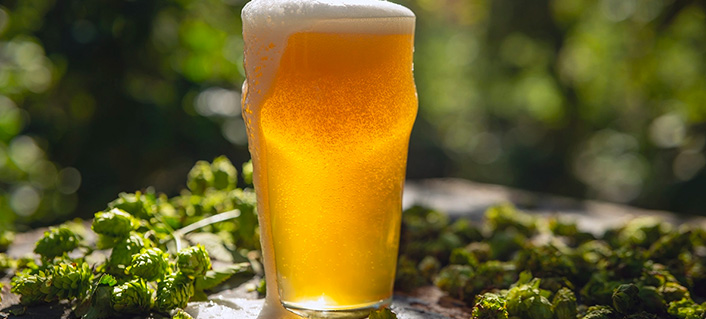
Unless you’ve been living in an alternate-universe monastery subsisting entirely on a liquid diet of hard seltzer, you’ve probably at least seen and perhaps tasted (or even brewed) a dip hopped beer. What is dip hopping, and what does it do, and should you try it? Please … set down the goblet of that bizarro-Trappist yuzu-sucrose concoction and step into the tank room with us.
Dip Hopping: A Quick Primer
Dip hopping was developed and described by a team of brewing scientists from Kirin in 2012 (if you’re an ASBC or MBAA member, you can see the Kirin team’s poster presentation on dip hopping from the 2018 Brewing Summit here).
Their findings showed that a low-temperature hop addition in between the whirlpool and dry hop additions in the fermentation vessel (FV) created a distinct effect: fruity and tropical qualities derived from linalool and geraniol were amplified, but piney and dank myrcene-related flavors were suppressed. Additional effects of dip hopping noted by the Kirin team were increased fermentation rate due to a reduction in dissolved CO; and reduced levels of 2M3MB (an onion-like off flavor), which was attributed to decreased HS levels resulting from CO purging conducted during the dip hop addition.
Like whirlpool hopping, dip hop additions help preserve volatile aromatics; and like dry hop additions, the extended contact in an FV creates opportunities for biotransformation.
The How of Dip Hopping
In a nutshell: hops are added to the fermenter fermentation begins, typically at a rate of 0.75 – 1.0 pounds per barrel.
Dip hops can be slurried with water or wort at a similar temperature to whirlpool additions – 150°-170°F (65.5° – 76.7°C) – and left in contact for 60 minutes or longer prior to pumping in cooled wort and pitching yeast.
Which Hops to Use?
Cascade
Centennial
Chinook
Motueka™
Styrian Golding Celeia
Amarillo®
Cascade
Centennial
Mt. Hood
Nugget
Pacifica™
Willamette
I Dip, You Dip, We Dip: Advice from Folks Who’ve Dip Hopped
- Dip hop at a rate of about .75-1.0 lbs. of hops per bbl. of wort.
- Knockout about 10% of kettle volume at 160 – 170°F, midway through boil.
- Keep FV sealed while dip hopping to trap aromatics in wort.
- Proceed with boil and whirlpool with the remainder of the volume as usual. Knockout batch cooler than normal to compensate for warm wort in FV, in order to pitch yeast as soon as the overall wort temp is safe and strain appropriate.
- Do not count on harvesting yeast from dip-hopped batches.
- Be aware dip hopping will impart BUs, craft recipes accordingly.
- Dip hopping seems to “soften” perception of calculated bitterness.